Art History Faculty Lecture with Elizabeth Browne | The Art of Earth: Clay and Crystal Form in Romé de l’Isle’s Cristallographie
September 15th, 2026 at 5:30 pm
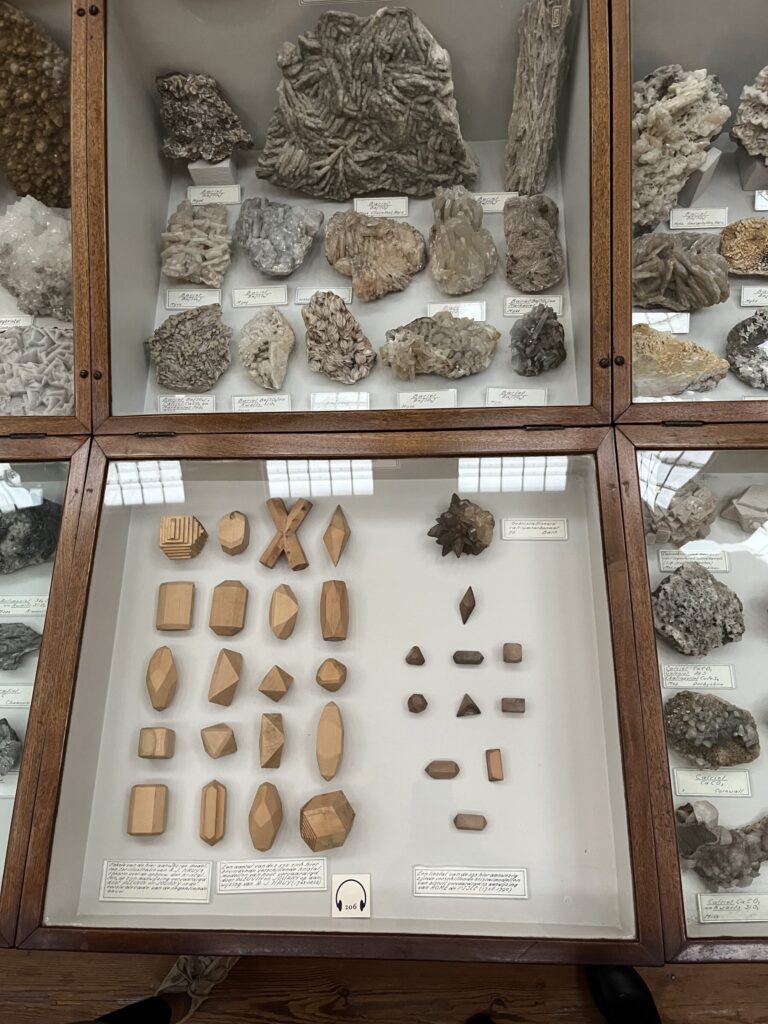
Terracotta models by Romé de l’Isle/François-Louis Swebach Desfontaines (at right in glass display case). Teylers Museum, Haarlem, Netherlands. Photo: Elizabeth Saari Browne.
Date & Time
September 15th, 2026 at 5:30 pm
Location
Lamar Dodd School of Art | N100
Type of Event
Faculty Research Lecture Series
Lectures
Academic Area
Art History
Featuring
Elizabeth Saari Browne
Host/Contact
Asen Kirin
Isabelle Loring Wallace
Join us for the first Art History Faculty Lecture of the 2026-2027 academic year with Assistant Professor Elizabeth Browne, who will present “The Art of Earth: Clay and Crystal Form in Romé de l’Isle’s Cristallographie”.
About the Lecture
In 1783, French mineralogist Jean-Baptiste Romé de l’Isle published his Cristallographie, accompanied by 438 engraved plates and a set of terracotta models made by artist François-Louis Swebach Desfontaines representing real and hypothetical crystalline forms. In his Introduction, Romé de l’Isle claimed that the clay models presented the specimens “in all [their] integrity” and would facilitate future study. Yet, the surviving models appear anything but ideal: they are warped, irregular, and contain occlusions. Rather than treating these deviations as failures of representation, I argue that their materiality collapses the distinction of specimen and proxy. The models do not simply represent terrestrial matter but materially participate in and reveal earth’s capacity to produce form.
In their apparent distortions, the ceramic models register the plasticity and contingency of terre—of earth and earthen matter. Indeed, their mutability materializes eighteenth-century theories of terrestrial matter (including clay) as active, formative, and perpetually generative. Natural philosophers from Ralph Cudworth and Jean LeClerc to Jean Gotschalk Wallerius and Pierre-Joseph Macquer described terre through the language of artistic production (notably, of the plastic arts), as at once formative and formable, its transformations exceeding stable classification. The material deviations of the clay crystals, then, make visible the very generative processes through which terrestrial matter was understood. The apparent inadequacy of Romé de l’Isle’s models thus becomes a means of knowing nature differently: not as a stable form awaiting accurate representation, but as an active material process whose capacity to generate form exceeds the classificatory systems intended to contain it.
About the Speaker
Elizabeth Saari Browne (PhD, MIT) is an art historian specializing in eighteenth- and nineteenth-century European art and material culture, with particular attention to sculpture, ceramics, and the gendered dimensions of artistic production, collecting, and authorship.
Her first book, Modeling Sculpture: Clodion and the Aesthetics of Terracotta (University of Delaware Press, Studies in Eighteenth-Century Art and Culture, forthcoming 2027), reconsiders the terracotta oeuvre of French artist Claude Michel, called Clodion (1738-1814), whose work has often been dismissed as merely decorative or facile. Instead, Browne situates Clodion’s engagement with terracotta within period debates about materiality, plasticity, and the formation of aesthetic value, demonstrating how the physical properties of clay challenged limitations to sculptural practice in the eighteenth century.
Her second book project extends her investigations into eighteenth-century conceptions of earthen clay, examining the material’s perceived agency across art-historical, literary, and mineralogical writings. Bringing the history of art into dialogue with natural history, the project considers how clay’s catalytic potential informed broader understandings of matter and artistic making.
Prior to joining the faculty at UGA, Browne worked in the curatorial departments of several museums, including Cooper Hewitt, Smithsonian Design Museum; the Museum of Fine Arts, Boston; and the Santa Barbara Museum of Art. Her work has been published in Art History, the Burlington Magazine, the American Ceramic Circle Journal, the French Porcelain Society Journal, as well as in edited volumes and exhibition catalogues. She is currently a 2025-2027 Lilly Teaching Fellow.
Upcoming Events
Research Day
September 21st, 2026
Jack Davis Lecture in Graphic Design with Georgianna Stout
October 6th, 2026 at 5:30 pm